
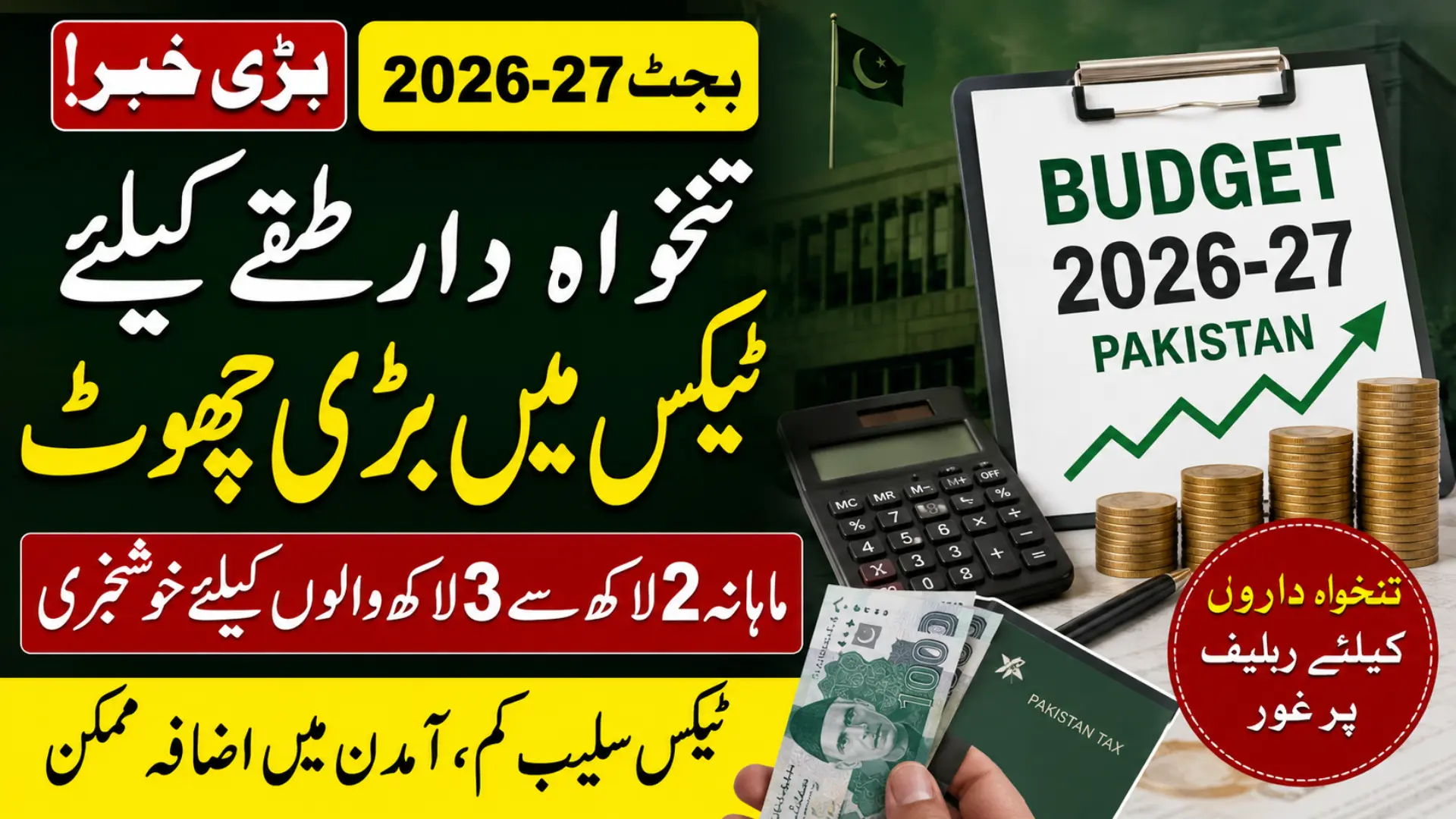
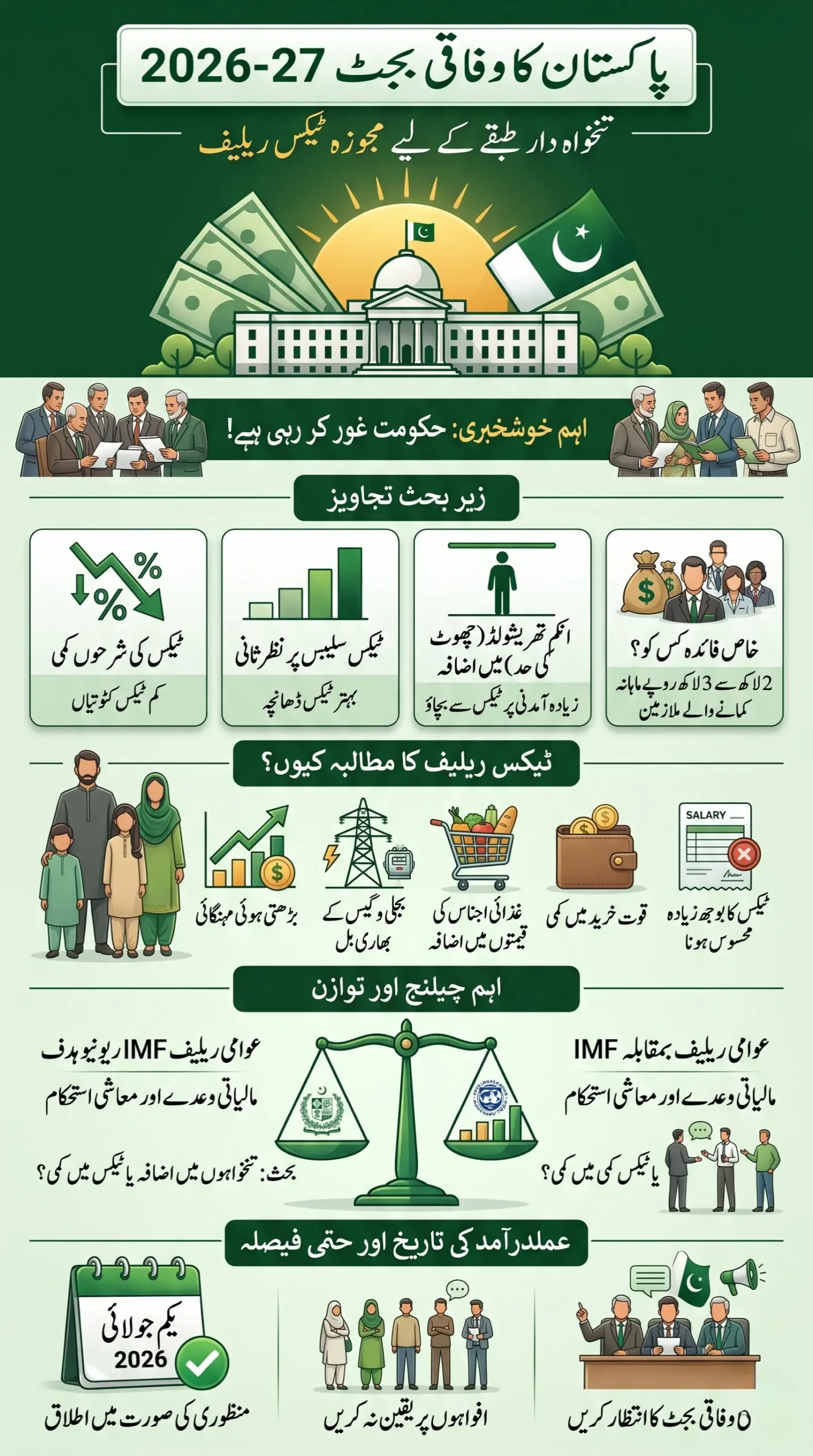
Pakistan Budget Tax Relief for 2026-27 is under serious discussion as the government considers reducing the tax burden on middle-income and salaried families. Proposed changes include lower income tax rates, revised tax slabs, higher income thresholds, and possible relief for employees earning between Rs 200,000 and Rs 300,000 per month.
The government is trying to balance public relief with IMF revenue targets and fiscal commitments. If approved, the new tax measures will take effect from July 1, 2026. Millions of taxpayers are waiting for the final budget announcement to see how much their monthly take-home income could increase.
Why Tax Relief Has Become a Major Budget Demand in Pakistan
Over the last few years, the salaried class has faced a difficult financial environment. While salaries have increased slowly, the cost of living has risen much faster.
Household budgets have been affected by:
- Higher electricity and gas bills
- Rising food prices
- Increased transportation costs
- Expensive school and university fees
- Higher healthcare expenses
- Increased housing and rent costs
Unlike many sectors of the economy, salaried employees cannot easily avoid taxation because income tax is deducted directly from their salaries. As a result, many taxpayers believe they are carrying a larger share of the country’s direct tax burden. This growing concern has pushed tax relief to the center of budget discussions.
Also Read: CM Punjab Minority Card Distribution Begins Across Punjab – Check Your Eligibility
What Pakistan Budget 2026-27 Discussions Are Suggesting
Several proposals are reportedly under review before the final budget announcement. The government is examining ways to provide targeted relief without creating a large revenue shortfall.
Possible measures being discussed include:
| Proposed Measure | Expected Benefit |
|---|---|
| Reduction in tax rates for middle-income earners | Higher take-home salary |
| Revision of tax slabs | Lower tax burden on certain salary brackets |
| Increase in income thresholds | Delay entry into higher tax rates |
| New tax slab introduction | Smoother tax progression |
| Review of surcharge rules | Relief for higher-income taxpayers |
These proposals remain under discussion and may change before final approval.
Current Income Tax Structure for Salaried Individuals
At present, salaried individuals are taxed according to income brackets.
| Annual Income | Approx. Monthly Income | Tax Rate |
|---|---|---|
| Up to Rs 600,000 | Up to Rs 50,000 | 0% |
| Rs 600,001 – Rs 1,200,000 | Rs 50,001 – Rs 100,000 | 1% |
| Rs 1,200,001 – Rs 2,200,000 | Rs 100,001 – Rs 183,333 | 11% |
| Rs 2,200,001 – Rs 3,200,000 | Rs 183,334 – Rs 266,667 | 23% |
| Rs 3,200,001 – Rs 4,100,000 | Rs 266,668 – Rs 341,667 | 30% |
| Above Rs 4,100,000 | Above Rs 341,667 | 35% |
Many taxpayers argue that these rates have become difficult to manage due to inflation and declining purchasing power.
Also Read: CM Ration Card 3000 Payment Released for Eligible Families – Verify Your Account Balance Today
Which Families Could Benefit the Most?
Current discussions indicate that middle-income households may receive the largest benefit if relief measures are approved.
This category generally includes:
- Government employees
- Private-sector workers
- Teachers and lecturers
- Bank employees
- Engineers
- IT professionals
- Healthcare workers
- Small business professionals drawing fixed salaries
Particular attention is reportedly being given to individuals earning between Rs 200,000 and Rs 300,000 per month because this group contributes significant tax revenue while also facing rising living expenses.
Why the IMF Matters in Budget Decisions
One question many Pakistanis are asking is:
“If the government wants to reduce taxes, why doesn’t it simply announce relief?”
The answer lies partly in Pakistan’s fiscal commitments. The government must maintain revenue targets and budget discipline while continuing economic reforms. Any major tax reduction could affect revenue collection.
Because of this, policymakers are attempting to find a balance between:
- Providing relief to taxpayers
- Meeting revenue targets
- Maintaining economic stability
- Avoiding a larger budget deficit
This is why budget discussions have focused on targeted relief rather than broad tax cuts.
Must Read: Cross Subsidy Program Apply Online 2026 – QR Code Registration Through PITC Portal
Tax Relief vs Salary Increase: Which Helps More?
A debate has emerged among policymakers regarding whether relief should come through salary increases or lower taxes.
Salary Increase
Advantages:
- Immediate rise in gross salary
- Helpful for government employees
Challenges:
- Increases long-term government expenditure
- Adds pressure on public finances
Tax Relief
Advantages:
- Improves take-home income
- Lower fiscal burden compared to large salary hikes
- Benefits both public and private-sector employees
Challenges:
- Reduces tax collection revenue
For many middle-income earners, a reduction in tax deductions could provide noticeable monthly relief without requiring massive increases in government spending.
How Tax Relief Could Affect Monthly Income
The exact impact will depend on the final budget. However, consider a professional earning Rs 250,000 per month.
| Scenario | Monthly Impact |
|---|---|
| Current tax deduction | Higher deduction |
| Reduced tax rate | More take-home salary |
| Revised tax slab | Lower annual tax burden |
| Higher income threshold | Delayed entry into higher tax brackets |
Even moderate changes could leave thousands of extra rupees in monthly household budgets.
Also Read: Petrol Subsidy Scheme Installments Approved For Motorcyclists In June – Know Step-by-Step
Important Questions Middle-Income Families Are Asking
Will everyone receive tax relief?
Not necessarily. Current discussions suggest targeted relief rather than universal tax reductions.
Could lower-income earners benefit too?
Possible adjustments to lower tax slabs may benefit employees earning below middle-income levels.
Will relief be permanent?
Tax measures announced in the federal budget generally apply for the new fiscal year but can be revised in future budgets.
Other Budget Measures Also Being Discussed
Apart from income tax relief, policymakers are reportedly reviewing several other taxation areas.
These include:
- Tax reforms in different sectors
- Revenue collection improvements
- Measures related to consumer goods
- Potential changes affecting vehicle taxation
- Expansion of the tax base
The final budget will likely contain a broader package rather than a single tax-relief announcement.
Also Read: MPIP Punjab Gov PK Internship Phase 2 Apply Online Via Portal
What Taxpayers Should Do Before the Budget Announcement
Many rumors circulate online during budget season. Taxpayers should:
- Wait for official budget documents
- Avoid relying on social media claims
- Check updated tax deductions after implementation
- Review salary slips carefully after July 2026
- Follow official government announcements
Budget proposals often change during the approval process, so only officially announced measures should be treated as final.
What Can Pakistanis Expect From July 2026?
If approved, new tax measures are expected to take effect from 1 July 2026, the beginning of the new fiscal year. Employers would then update payroll systems and apply revised withholding tax deductions accordingly.
For millions of salaried workers, the biggest question remains whether the final budget will deliver enough relief to offset rising living costs. At this stage, discussions are ongoing, and taxpayers should expect greater clarity once the federal budget is formally presented.
Also Read: Good News: BISP Financial Assistance for Unmarried Women Above 35 Years Approved
FAQs
What is Pakistan Budget Tax Relief 2026-27?
It refers to proposed measures being discussed to reduce the income tax burden on salaried and middle-income individuals in Pakistan during the 2026-27 fiscal year.
Will middle-income families get tax relief in Budget 2026-27?
Current discussions suggest that middle-income earners are among the primary groups being considered for tax relief, but no final approval has been announced.
Which salary group may benefit the most?
Reports indicate that employees earning roughly between Rs 200,000 and Rs 300,000 per month may receive the greatest benefit if proposed changes are approved.
Will income tax slabs change in Pakistan?
Possible revisions to tax slabs, income thresholds, and tax rates are under consideration, but official confirmation is still awaited.
When will new tax rates be implemented?
If approved in the federal budget, revised tax measures are expected to become effective from 1 July 2026.
Why is the salaried class demanding tax relief?
Many salaried workers believe inflation, utility bills, housing costs, and other living expenses have increased faster than their incomes, making current tax deductions more difficult to manage.
Can IMF conditions affect tax relief?
Yes. Any major tax changes must align with Pakistan’s fiscal commitments and revenue targets, which is why discussions are focused on targeted rather than broad-based relief.
Final Words
The debate around Pakistan Budget Tax Relief highlights a challenge faced by many middle-income families across the country. Salaried employees continue to contribute a significant share of direct taxes while also dealing with rising household expenses. That is why expectations from Budget 2026-27 are particularly high.
Although several relief proposals are under discussion, nothing is final until the federal budget is officially announced. If approved, revised tax slabs, lower rates, or adjusted income thresholds could provide meaningful support to thousands of families struggling with the cost of living. Until then, taxpayers should follow official announcements and avoid treating budget rumors as confirmed policy.