
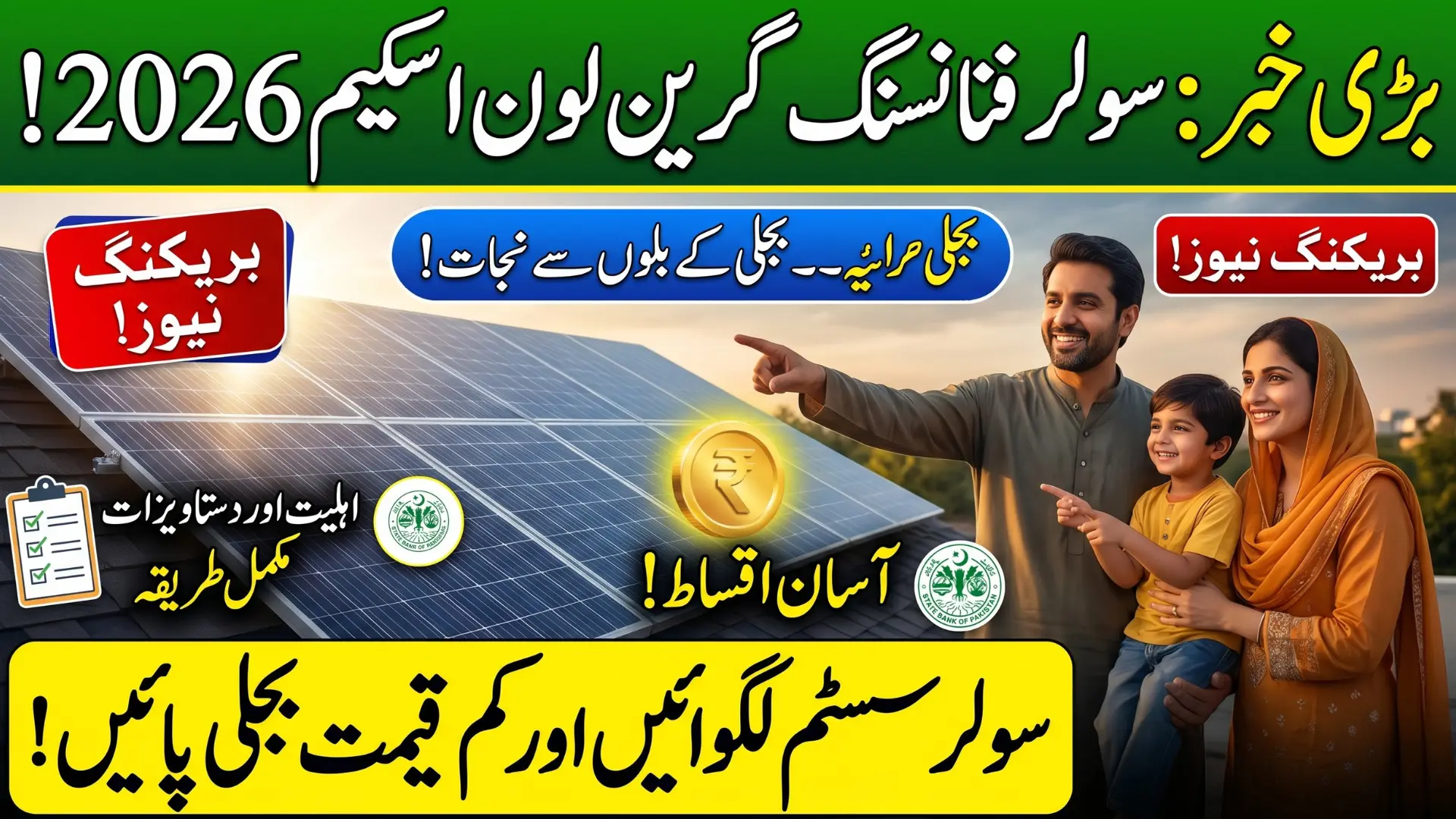
Electricity bills in Pakistan are rising every month, pushing many households to look for a permanent solution. The Solar Financing Green Loan Scheme in 2026 is giving people a chance to install solar systems without paying the full cost upfront. Through financing offered by major banks, citizens can now switch to solar energy with easy monthly installments and low markup rates.
In this guide, we will explain the Solar Financing Green Loan Scheme in detail, including eligibility criteria, required documents, and the complete bank loan process. If you want to reduce your electricity bills and move toward clean energy, this article will help you understand everything step by step.

Why Solar Financing is Becoming Popular in Pakistan
For years, people in Pakistan complained about electricity shortages and rising bills. But the situation changed drastically in recent years as tariffs increased significantly. Instead of paying huge monthly bills, many households are switching to solar systems through financing options.
Here’s why the Solar Financing Green Loan Scheme is gaining attention:
- Electricity prices are increasing every year
- Solar technology has become cheaper and more efficient
- Banks are offering low-markup green loans
- Solar systems increase property value
- Monthly electricity costs drop immediately
For many families, installing solar is now seen as a financial investment rather than a luxury.
Also Read: Suzuki GSX 125 Installment Plan: 0% Markup with Easy Monthly Payments – Know Full Details
Quick Info – Solar Financing Green Loan Scheme 2026
| Feature | Details |
|---|---|
| Scheme Name | Solar Financing Green Loan Scheme |
| Supported By | State Bank of Pakistan |
| Financing Banks | Bank Alfalah, Meezan Bank, MCB Bank |
| Mark-up Rate | Around 6% – 8% |
| Repayment Period | 3 to 7 Years |
| Purpose | Install residential or commercial solar systems |
| Additional Benefits | Insurance coverage and flexible installments |
What is the Solar Financing Green Loan Scheme?
The Solar Financing Green Loan Scheme is a banking facility designed to help people install solar systems without paying the full amount upfront.
Under this program:
- Banks provide financing for solar panels and equipment
- Customers repay the loan through monthly installments
- The loan usually covers installation and equipment cost
The scheme is aligned with the renewable energy goals supported by the Alternative Energy Development Board in Pakistan. This means the government and financial sector both want to encourage the use of clean energy.
Read More: Maryam Nawaz Wheat Subsidy Program Application Check – Step-by-Step April 2026 Update
Key Benefits of the Solar Financing Green Loan Scheme
Solar financing comes with several advantages for households and businesses.
Major Benefits
- Reduced electricity bills
- Affordable monthly installments
- Environment-friendly energy solution
- Increase in property value
- Insurance protection for solar equipment
- Lower dependence on grid electricity
For many families struggling with monthly electricity costs, this scheme provides real financial breathing space.
Loan Mark-up Rate and Repayment Period
One of the biggest attractions of the scheme is its concessional financing.
Financing Details
- Mark-up Rate: Around 6% to 8%
- Repayment Period: 3 to 7 years
- Installments: Monthly payment plans
- Insurance: Solar equipment usually insured by banks
Because of the long repayment period, the monthly installment often becomes equal to or even lower than the electricity bill.
Also Read: Kisan Diesel Subsidy Program Update 1500 Diesel Subsidy Released – Are You Eligible?
Who Is Eligible for Solar Financing in Pakistan
Not everyone automatically qualifies for the Solar Financing Green Loan Scheme. Banks evaluate financial stability before approving applications.
Generally, the following people are eligible:
- Salaried individuals with stable income
- Business owners with financial records
- Active tax filers
- Property owners installing solar on their residence
- Customers with a clean banking history
Applicants must also have a regular electricity connection and provide recent electricity bills.
Documents Required for Solar Loan Application
To apply for solar financing, banks require basic documentation to verify the applicant’s financial capacity.
Commonly required documents include:
- Copy of CNIC
- Last 6 months electricity bills
- Income proof or salary slips
- Bank statements
- Tax filer status
- Property ownership or residence verification
Some banks may request additional documents depending on the loan amount.
Also Read: Big Update: Interest-Free E-taxi Program Portal Update For Registration Step-By-Step Guide
Step-by-Step Bank Loan Process for Solar Installation
The loan process for the Solar Financing Green Loan Scheme is fairly simple. Most banks follow a similar procedure.
Step 1: Select Solar System Size
First, the customer consults a solar vendor to determine system size based on electricity usage.
Step 2: Choose a Partner Bank
Customers can approach banks like Bank Alfalah, Meezan Bank, or MCB Bank that offer green energy financing.
Step 3: Submit Loan Application
Applicants submit required documents along with the solar system quotation.
Step 4: Bank Assessment
The bank evaluates:
- Income stability
- Credit history
- Loan repayment capacity
Step 5: Loan Approval
Once approved, the bank releases payment directly to the solar vendor.
Step 6: Solar System Installation
The vendor installs the solar panels and the customer begins paying monthly installments.
Is Solar Financing Still Worth It After Net Billing Changes?
Some people became confused after new net billing regulations in 2026. However, experts say solar financing still makes financial sense.
Here is why:
- Solar reduces electricity bills immediately
- Payback period remains reasonable
- Property value increases with solar installation
- Energy independence during power outages
Even with regulatory changes, solar remains one of the most practical energy solutions in Pakistan.
Also Read: Today Update! PMLYS Application Status 2026 – Guide to Check Laptop Merit & Eligibility
Real-Life Benefits for Pakistani Households
For an average household paying Rs.40,000 to Rs.60,000 electricity bills, switching to solar through the Solar Financing Green Loan Scheme can bring significant relief.
Some real benefits include:
- Monthly electricity bills dropping drastically
- Protection from tariff increases
- Cleaner environment through renewable energy
- Long-term savings after loan repayment
Many families say solar has transformed their monthly budget by reducing utility expenses.
Important Tips Before Applying
Before applying for the Solar Financing Green Loan Scheme, keep these points in mind:
- Compare financing plans of multiple banks
- Choose reliable solar installation companies
- Understand net-metering and billing policies
- Calculate your monthly savings before applying
Taking these precautions ensures that your solar investment remains profitable.
Free Insurance — What It Actually Covers
One feature of the 2026 green loan packages that does not get enough attention is the bundled system insurance that most participating banks are now including.
Your solar panels, inverter, and associated equipment are covered against:
- Theft: panels on rooftops are unfortunately a target in some areas
- Fire damage: whether from electrical fault or external causes
- Natural disasters: flood, hailstorm, storm damage
- Equipment malfunction: some banks include limited warranty-linked coverage
This insurance runs for the duration of your loan repayment period at no additional cost. For a system worth Rs. 700,000 to Rs. 1,000,000, having it fully insured is a significant piece of mind and it removes one of the biggest objections people have about investing in solar.
Also Read: PM Laptop Scheme 2026 Application Process – Merit List & Registration Details
Final Thoughts
With electricity prices hitting record highs, the Solar Financing Green Loan Scheme has arrived at the right time for Pakistani households. Instead of struggling with rising power bills, people now have a practical path to energy independence.
Thanks to support from the State Bank of Pakistan and financing packages offered by banks like Bank Alfalah, Meezan Bank, and MCB Bank, installing a solar system is becoming easier than ever.
For families looking to secure their energy future, switching to solar through bank financing may be one of the smartest financial decisions in 2026.